OCR, ML, LLM, and Agentic AI: The Evolution of AI in Intelligent Document Processing
Veröffentlicht am 07.05.2026
Lesedauer: 11 min

Contents
- AI and Document Automation: What’s Behind it?
- The Evolution of Technology: Four Stages on the Path to True AI-Driven Document Automation
- Why Multi-LLM Document Processing and Green Voting Are Better Than a Single Model
- The Concrete Benefits of Intelligent Document Processing
- Use Cases: How AI-Powered Document Automation Works in Practice
- Data Sovereignty and the GDPR: A Topic Many Providers Avoid
- AI Washing: 5 Warning Signs and 7 Specific Questions to Ask
- Conclusion
- FAQ: Intelligent Document Processing
- Digitize Business Processes & Gain Many Benefits
Inhalt
- AI and Document Automation: What’s Behind it?
- The Evolution of Technology: Four Stages on the Path to True AI-Driven Document Automation
- Why Multi-LLM Document Processing and Green Voting Are Better Than a Single Model
- The Concrete Benefits of Intelligent Document Processing
- Use Cases: How AI-Powered Document Automation Works in Practice
- Data Sovereignty and the GDPR: A Topic Many Providers Avoid
- AI Washing: 5 Warning Signs and 7 Specific Questions to Ask
- Conclusion
- FAQ: Intelligent Document Processing
- Digitize Business Processes & Gain Many Benefits
Ever since ChatGPT, AI has ceased to be a niche term. “We need AI now, too”—this phrase is currently being heard in many executive and finance meetings. The expectation behind it: less effort, more automation. And almost every software solution today is labeled “AI-powered” accordingly. But what does that actually mean? And what’s really behind it when providers talk about “intelligent document processing”?
AI and Document Automation: What’s Behind it?
Many companies today buy solutions marketed as “AI,” but what they get is:
- Classic OCR with a few rules
- Machine learning models with limited flexibility
- Or isolated tools without an end-to-end process
It depends heavily on the specific provider. “AI” is not a protected term or a uniform standard. The buzzword can encompass a wide range of technological approaches, from rule-based pattern recognition to the latest generation of self-learning language models.
For decision-makers in finance and procurement, however, this is important: anyone evaluating a solution for automating incoming invoices, expense reports, or order confirmations should know what technology actually powers it and what that means in concrete terms for accuracy, maintenance requirements, and scalability.
Another problem: AI is often sold as a feature, not as a system. In intelligent document processing, however, it is not the individual technology that matters, but the interaction of multiple components throughout a process.
So how can you gain a better overview and assess the information more effectively? Here, it’s worth taking a look at the four stages of technological evolution the industry has gone through in recent years.
The Evolution of Technology: Four Stages on the Path to True AI-Driven Document Automation
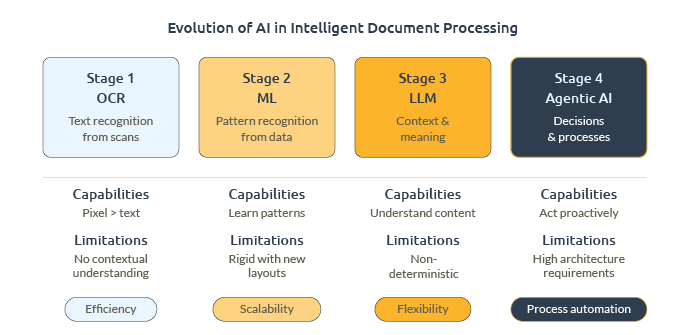
Intelligent document processing has evolved in several stages:
Stage 1: OCR
Optical character recognition (OCR) converts scanned documents or image-based PDFs into machine-readable text. Traditional OCR systems operate on a character-by-character basis: they recognize that certain pixels resemble an “R,” but do not understand that this “R” is part of an invoice amount.
However, OCR capabilities have advanced tremendously in recent years, and now even more complex layouts or handwritten notes and annotations can be reliably extracted. We’ve taken a closer look at the evolution of OCR in our guide article “OCR: Text Recognition from Different Perspectives.”
Stage 2: Machine Learning: Patterns Instead of Rules
ML-based systems learn from sample data. Instead of fixed rules, they recognize patterns in the document layout and can read it accurately as long as the document adheres to known patterns.
The limitation: For every new document type or layout, the model requires retraining. If a supplier changes their invoice layout, the system may not recognize it correctly.
Stage 3: LLMs: Context Instead of Structure
Large Language Models (LLMs) such as GPT-4 or comparable models are fundamentally changing the game: for the first time, true understanding comes into play. When LLMs encounter a document for the first time, they understand—even without prior training—that “excl. VAT,” “plus VAT,” and “net of VAT” are semantically identical. This means the models can:
- Interpret content
- Recognize relationships
- Process unstructured data
They understand documents in context. And in doing so, LLMs provide a huge boost to document processing. Their concrete benefits are evident, among other things, in the interpretation of item data, the detection of discrepancies, or context-based validation.
However: LLMs are not deterministic. They provide probabilities, but no guaranteed results.
Stage 4: Agentic AI: From Understanding to Action
Agentic AI is the logical next step: AI systems that not only extract data but also proactively make decisions, trigger follow-up processes, and learn from every interaction. In intelligent document processing, this means: the system recognizes an invoice, matches it against the purchase order, suggests the account assignment, forwards it to the responsible approver, and sends a reminder if no response is received.
Agentic AI can, among other things:
- Execute process steps independently
- Prepare or make decisions
- Coordinate multiple systems
- Execute multiple tasks sequentially
It serves as a robust technological foundation upon which modern solutions, such as free-com’s incoming invoice processing, are built.
Important: Many providers are already using the term “agents,” even though they only offer simple workflows and lack true decision-making logic. It’s always worth taking a closer look or asking for details to avoid falling for “AI washing” (see below).
Why Multi-LLM Document Processing and Green Voting Are Better Than a Single Model
Anyone relying on LLM-based document processing today faces an important question: should I trust a single model? A single model sounds efficient, but it’s risky. The problem is that LLMs produce probabilistic results, and errors aren’t always predictable.
The so-called Green Voting principle, as used in our incoming invoice solution, addresses precisely this problem. Instead of querying a single LLM, multiple language models are applied in parallel to the same task. Only when the models reach a consensus—that is, give the “green light”—is the result marked as verified. If the models differ from one another, the document is forwarded for manual review.
| Single LLM | Multi-LLM Document Processing with Green Voting |
|---|---|
| One model, one output | Multiple models, consensus-based |
| No internal cross-checking | Discrepancies are actively detected |
| Errors can slip through unnoticed | Only verified results are processed automatically |
| High touchless processing rate, but riskier | High touchless processing rate with greater reliability |
The result: Companies benefit from maximum automation without sacrificing control. Especially in the financial sector, where accounting errors can have serious consequences, this isn’t just a nice-to-have—it’s a must.
The Concrete Benefits of Intelligent Document Processing
According to the 2025 AIIM/Deep Analysis study, which surveyed 600 executives from the U.S. and the DACH region, 50% of respondents cited shorter processing times as the primary benefit of intelligent document processing. This benefit far outweighs the argument of reduced personnel costs (30%). This shifts the perspective: AI-driven document automation is not a cost-cutting tool, but a lever for efficiency and quality.
Additional figures:
- 78% of companies already use AI in document processing workflows
- Intelligent document processing reduces manual effort by up to 80%
- Up to €15 can be saved per incoming invoice with intelligent invoice processing
Use Cases: How AI-Powered Document Automation Works in Practice
What does intelligent document processing look like in practice? We have a few concrete use cases for you:
Incoming Invoice Processing: From Format Chaos to a Seamless Process
The problem sounds familiar to many: Invoices arrive as paper, PDF, scans, XML, XRechnung, or ZUGFeRD. Every format, every supplier, every branch operates differently. The result: media breaks, manual data entry, errors, late payments, and missed discounts.
A modern AI solution for incoming invoice processing solves exactly that. Not through format standardization, but through a seamless
Learn more about free-com’s digital invoice processing
Travel and expense reporting: Receipts that “submit themselves”
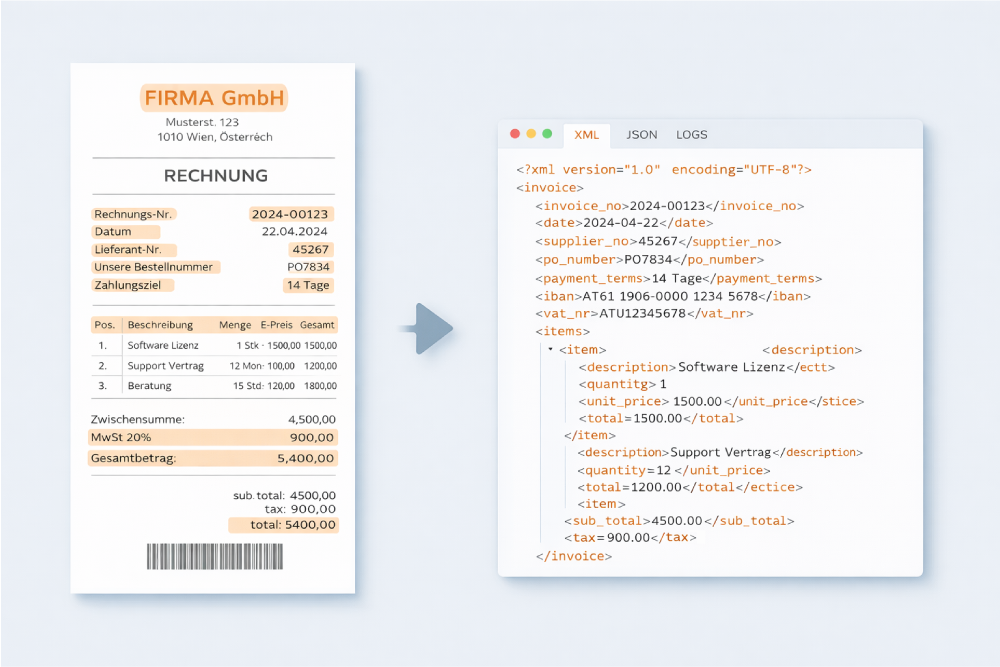
Expense receipts are a prime example of manual and inefficient work: Employees collect receipts, photograph them, enter the amounts… and then the accounting department manually verifies everything. AI-powered receipt capture turns the process on its head: employees photograph the receipt, the AI extracts the date, amount, category, and VAT, assigns it to the correct cost center, and automatically forwards the claim to the approval workflow.
For companies with many field staff or frequent travel, this pays off particularly quickly: fewer errors, faster reimbursement, and GDPR-compliant archiving without paper files.
More on automated travel expense and expense reporting
Order confirmations: no more manual reconciliation
Order confirmations from suppliers are a silent time-sink for many purchasing departments: the document arrives via email, an employee opens it, manually reconciles items with the order, and passes on any changes. AI-powered processing fully automates this reconciliation. Delivery dates, prices, quantities: the AI immediately detects discrepancies and reports them specifically.
Data Sovereignty and the GDPR: A Topic Many Providers Avoid
When large language models (LLMs) come into play, the question inevitably arises: where exactly does the data end up? When a system sends sensitive data—such as invoices, supplier information, or terms and conditions—to a language model, does it end up on a U.S. server? Is it used to train public models? Can third parties access it?
This is important for companies in the DACH region. The GDPR, trade secrets, and compliance requirements make data sovereignty a critical strategic decision.
The good news: technically mature solutions can now combine GDPR compliance with AI performance. The key is that the provider actively addresses this question and does not evade it.
| Risks Associated with Uncritical AI Selection | free-com’s Approach |
|---|---|
| Data flows to US servers | Exclusively European-hosted instances |
| Training data derived from customer data | No Training: no use for public models |
| Unclear under data protection law | 100% GDPR-compliant, European legal jurisdiction |
| Vendor lock-in due to proprietary models | Multi-LLM approach, no vendor lock-in with a single model |
AI Washing: 5 Warning Signs and 7 Specific Questions to Ask
Hardly any term is used as liberally today as “artificial intelligence.” The problem is that not everything labeled “AI” actually contains AI—or at least not to the extent that is suggested.
This is precisely where what can be described as AI washing begins.
In this process, technologies are elevated with the “AI” label without actually offering any substantial technological added value. This is no trivial problem, because the decision to adopt a supposedly “intelligent” solution has direct implications for:
- Investments
- Process quality
- Scalability
- And, not least, expectations within the company
This makes it all the more important to take a closer look. Five warning signs of AI washing are:
- No explanation of the technology
- No information on error rates
- No distinction between OCR and AI
- No integration into processes
- No handling of exceptions
The following seven questions can help you develop a better understanding of what you’re dealing with in a specific case:
- 1
Question 1: What specific AI technology is behind this? (Rule-based, ML, LLM, multi-LLM?)
- 2
Question 2: Does the solution require manual training for new suppliers or formats?
- 3
Question 3: How are errors detected and escalated? Is there a consensus mechanism?
- 4
Question 4: Where is the data processed? Within the EU or in a global cloud?
- 5
Question 5: Is my company’s data used to train public models?
- 6
Question 6: Are there traceable audit trails for each processing step?
- 7
Question 7: How does the solution integrate with existing ERP and financial accounting systems?
A provider that can answer these questions clearly and comprehensively has AI integrated throughout its entire architecture.
Conclusion
What began as simple text recognition has evolved into a self-learning, proactive process engine that not only reads documents but also understands, verifies, and processes them. The evolution from OCR to Agentic AI thus has a direct impact on your process costs, error rates, and the workload on your teams.
The key point is this: AI alone does not solve anything. What makes the difference is a consistent end-to-end process: from document capture through intelligent extraction and validation to audit-proof archiving. When all of this is set up as a seamless, integrated, and interconnected process, you have a truly “smart” process: with measurably less effort, demonstrably fewer errors, and concrete financial savings. And you have a system that grows alongside your business over the long term.