
Statute of Limitations on Invoices: What You Need to Know as a Business Owner
Veröffentlicht am 17.03.2026
Lesedauer: 8 min

Contents
- What does the Statute of Limitations on Invoices Mean?
- An Overview of Statutes of Limitations: Austria vs. Germany
- How Do Reminders Affect the Statute of Limitations?
- Legal Consequences of Expired Statutes of Limitations
- 8 Tips for Preventing Your Invoices from Becoming Time-Barred
- Frequently Asked Questions About the Statute of Limitations on Invoices
Inhalt
- What does the Statute of Limitations on Invoices Mean?
- An Overview of Statutes of Limitations: Austria vs. Germany
- How Do Reminders Affect the Statute of Limitations?
- Legal Consequences of Expired Statutes of Limitations
- 8 Tips for Preventing Your Invoices from Becoming Time-Barred
- Frequently Asked Questions About the Statute of Limitations on Invoices
You provided a service, sent the invoice, and somewhere amid the daily stress of bookkeeping, it simply slipped your mind. No reminder was sent, no follow-up was made. Three years later, you notice the open claim again. But it’s too late: The invoice has expired, and the claim is effectively worthless.
In this article, you’ll learn how the statute of limitations works for invoices, what differences exist between Austria and Germany, when exceptions apply, and how you can actively prevent your claims from becoming time-barred.
What does the Statute of Limitations on Invoices Mean?
The statute of limitations on an invoice means that, once a legally defined period has expired, the creditor loses the right to enforce the claim in court. The debtor may raise the so-called statute of limitations defense and refuse to pay without facing legal consequences.
An important point that is often misunderstood: The statute of limitations on an invoice does not result in the claim being legally extinguished. It continues to exist as a so-called obligation in kind—meaning the debtor may pay voluntarily, and such a payment is not considered unjust enrichment. In practice, however, a claim subject to the statute of limitations is rarely collectible.
For businesses, the statute of limitations on invoices thus has direct economic implications: Those who do not actively monitor their outstanding items risk the complete loss of their claims.
An Overview of Statutes of Limitations: Austria vs. Germany
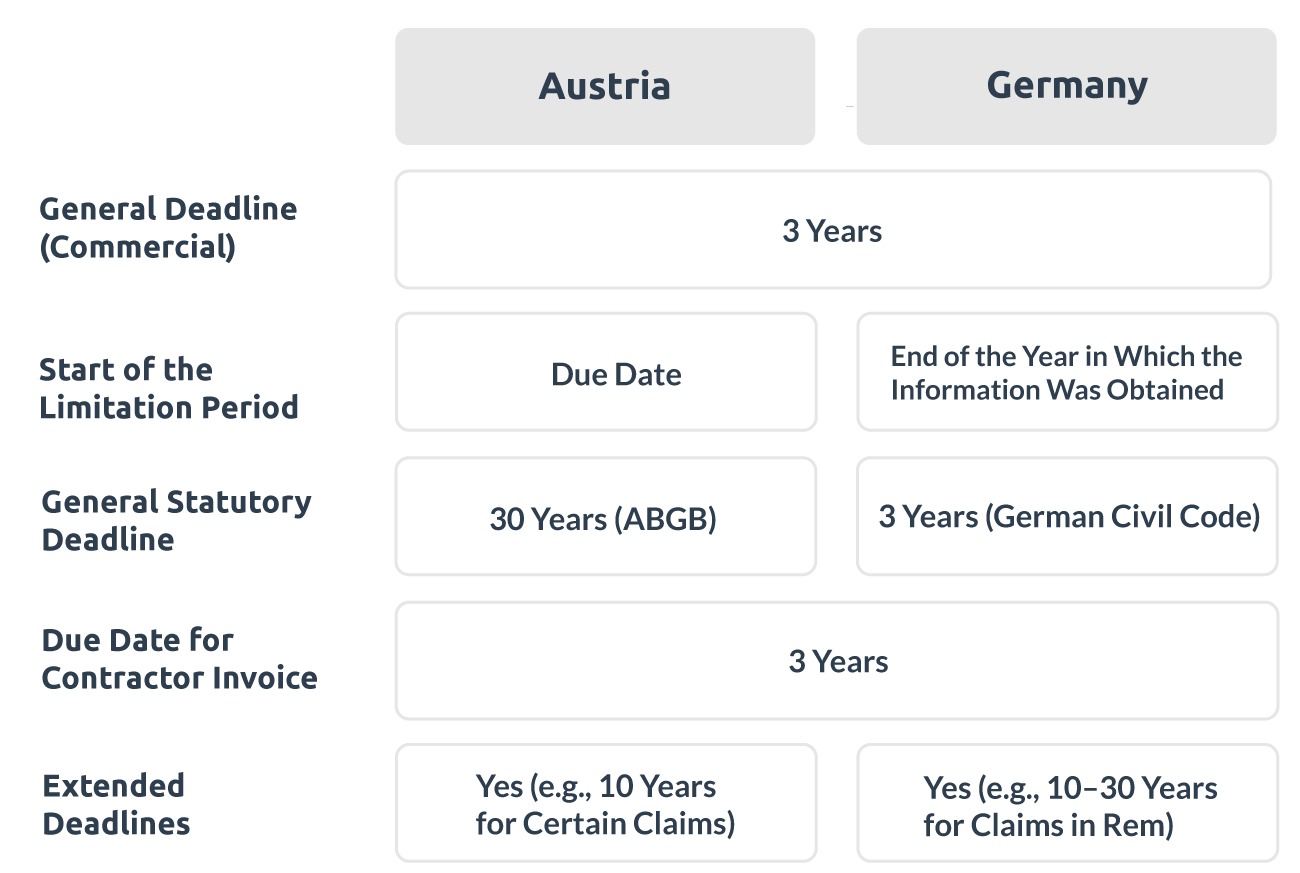
The rules governing the statute of limitations for invoices differ between Austria and Germany, both in terms of the length of the limitation periods and the point at which the period begins to run. Both factors are decisive in determining when an invoice is actually time-barred.
Statute of Limitations for Invoices in Germany
In Germany, the statutory limitation period of three years applies to most commercial claims pursuant to Section 195 of the German Civil Code (BGB). However, the period does not simply begin on the invoice date: it starts only at the end of the year in which the claim arose and the creditor became aware of it or should have become aware of it.
Example: A commercial invoice is issued on March 15, 2022. The statute of limitations begins on December 31, 2022, and ends on December 31, 2025.
Statute of Limitations for Invoices in Austria
In Austria, the legal situation is somewhat more nuanced. The ABGB provides for a general statute of limitations of 30 years, which, however, is superseded in commercial transactions by numerous shorter special periods. For the majority of commercial claims—that is, the statute of limitations for invoices in the commercial sector—a period of three years applies.
The key difference from Germany lies in when the statute of limitations begins: In Austria, the statute of limitations generally begins on the due date of the claim. In practice, this can mean that claims in Austria become time-barred sooner than comparable claims in Germany.
Example: A commercial invoice is issued on March 15, 2022, with a payment term of 30 days. The due date is April 14, 2022—the statute of limitations therefore expires on April 14, 2025.
How Do Reminders Affect the Statute of Limitations?
One of the most important questions in accounts receivable management is: When does the statute of limitations expire for an invoice with a reminder, and when does it expire for an invoice without a reminder? The answer depends on the legal effect of the respective action.
Without a Reminder: The Statute of Limitations Runs Unimpeded
If no measure is taken after the invoice is issued to suspend or interrupt the statute of limitations, the limitation period simply runs its course. An invoice without a reminder thus becomes time-barred after the regular period expires. In most commercial cases, this means after three years. Anyone who does not actively pursue their outstanding claims quietly loses their right to them.
With a Reminder: Suspension, but no Interruption
An out-of-court reminder—that is, a simple reminder letter to the debtor—does not automatically suspend the statute of limitations. This is a common misconception: A payment reminder or demand for payment alone does not halt the statute of limitations period in most cases, neither in Austria nor in Germany.
However, a demand letter can serve an important purpose: it documents that the creditor is actively pursuing their claim and is a key prerequisite for further legal action. Additionally, a written acknowledgment by the debtor—such as a partial payment, a request for a deferral, or an explicit confirmation of the debt—can interrupt the statute of limitations or cause it to restart.
An important difference between Austria and Germany: In Austria, legal action interrupts the statute of limitations. The limitation period starts over once the proceedings are concluded. In Germany, the same measures generally result in a suspension of the statute of limitations. The limitation period is paused and resumes after the suspension ends; however, once a final judgment is issued, a new ten-year limitation period begins.
In practice, this means: Anyone who wants to know when a bill with a reminder becomes time-barred must carefully examine what type of reminder or measure was taken and whether the debtor responded to it.
Legal Consequences of Expired Statutes of Limitations
What exactly happens when the statute of limitations on an invoice has expired? First, the most important point: The statute of limitations does not take effect automatically. The debtor must actively raise the statute of limitations defense, meaning they must explicitly point out that the claim is time-barred. If they do not do so, the creditor can, in theory, continue to assert their claim.
In practice, however, a statute-barred claim usually means the loss of the claim. An overview of the most important legal consequences:
1. No Longer Enforceable in Court
If the debtor raises the statute of limitations defense, a lawsuit will fail. The court will dismiss the claim as time-barred, regardless of whether the debt actually exists.
2. Voluntary Payment Remains Possible
A claim that has expired under the statute of limitations does not disappear entirely. The debtor may pay voluntarily—and has no right to reclaim the amount paid. In practice, however, this is the exception.
3. Impact on Accounting
A past-due receivable that is highly unlikely to be collected must be written off in the books as a bad debt. This reduces profits but can have at least a partially positive effect for tax purposes. In addition, there is generally a right to reclaim any sales tax or value-added tax that has already been paid. Depending on the amount of the receivable, this can provide significant relief. The exact procedure should be coordinated with a tax advisor.
8 Tips for Preventing Your Invoices from Becoming Time-Barred
The good news: In most cases, you can prevent invoices from becoming time-barred—provided you manage your receivables actively and systematically. The following tips will help you do just that:
Frequently Asked Questions About the Statute of Limitations on Invoices
Do You Have Any Questions For Us?
We will be happy to consult you during a short, non-binding online appointment!