An Overview of E-Invoice Formats: What Businesses in Germany and Austria Need to Know
Veröffentlicht am 30.04.2026
Lesedauer: 8 min

While many companies still send PDF files via email and refer to this as “digital,” the EU has a fundamentally different definition when it comes to e-invoice formats. The differences are not merely technical. They determine whether an invoice is even legally valid in Germany, and they are also becoming increasingly relevant for Austrian businesses.
This article provides a structured overview of the most important e-invoice formats, explains the differences between EDI, XML, and hybrid approaches such as ZUGFeRD, and outlines the current legal landscape in Germany and Austria as well as what it will look like in the coming years.
What is an E-Invoice Format?
Before comparing the different formats, it’s worth clarifying the basics. In everyday use, the term “e-invoice” often refers to two different things.
Unstructured electronic invoices are files such as PDFs or scanned documents. They look digital, but are barely readable by machines. Someone has to open them, read them, and manually enter the relevant data into the accounting system—or at least verify it.
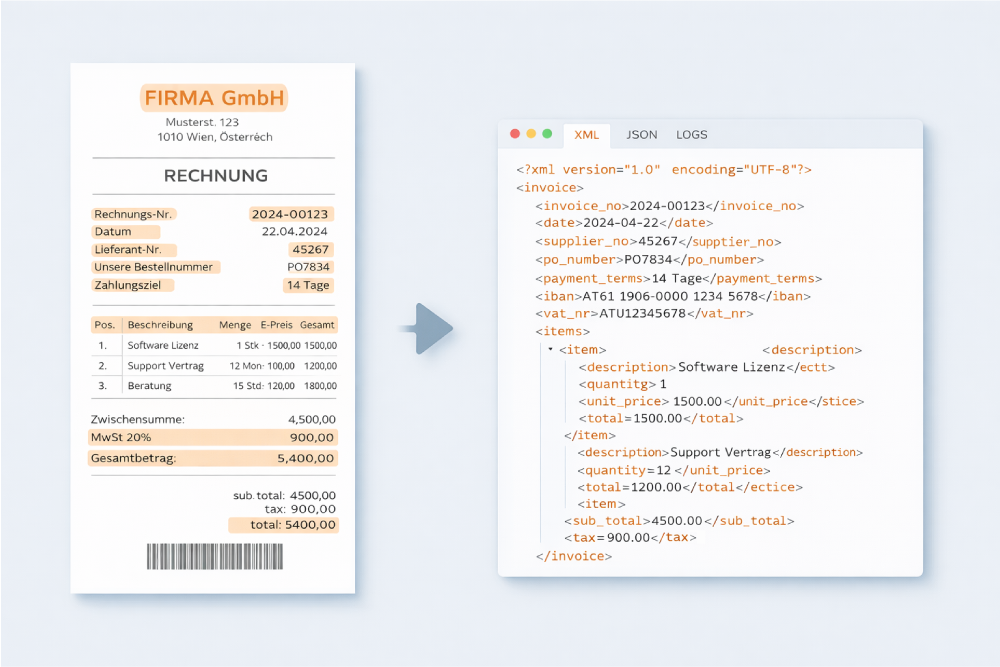
Structured electronic invoice formats, on the other hand, transmit all invoice data in a machine-readable form, such as XML or EDI. They can be imported directly and automatically into accounting and ERP systems without any human intervention.
Important: Many European legislators make a very clear distinction between the two definitions. In Germany, for example, the definition of an “e-invoice” was adjusted with the introduction of mandatory e-invoicing: An invoice is only a true e-invoice if it is in a structured, machine-readable format in accordance with the European standard (EN 16931). A PDF is therefore no longer considered an e-invoice, but merely an “other invoice.”
An Overview of the Most Important Electronic Invoice Formats
The landscape of electronic invoice formats in Europe is anything but uniform. Different standards are used depending on the country, industry, and specific use case. Broadly speaking, three categories can be distinguished: pure XML-based structured formats, hybrid formats that combine XML and PDF, and the older EDI invoice format. The most important examples are explained individually in the following sections.
EDI Invoice Format: The Pioneer with Pitfalls
The EDI (Electronic Data Interchange) invoice format is one of the oldest standards for electronic invoice exchange. Developed as early as the 1970s, EDI was for a long time the only way to transfer invoices between companies in a structured manner. Today, it is primarily found in wholesale and retail as well as in established industrial networks.
EDI’s strength lies in its robustness and its long-standing track record in certain industries. Its weakness is structural: data structures must be defined separately for each business partner and mapped to the system. This makes implementation disproportionately time-consuming compared to other formats.
In Germany, the EDI invoice format will still be permitted even after the mandatory e-invoicing requirement takes effect in 2025—but only on the condition that the transmitted data is fully compatible or interoperable with EN 16931, and with the recipient’s explicit consent. This transitional option remains in effect until the end of 2027.
ZUGFeRD Format: The Hybrid Solution in Germany
The ZUGFeRD invoice format is the answer to a common dilemma: How can an invoice be both machine-readable and understandable to humans?
ZUGFeRD (Central User Guide of the German Electronic Invoice Forum) solves this by combining a visual PDF/A-3 file with an embedded XML file. The PDF page looks like a standard invoice: it can be printed, sent via email, and read by humans. The embedded XML file contains the same data in a structured format and can be automatically imported into accounting systems.
Additional advantages of the ZUGFeRD format:
- In terms of content, ZUGFeRD is identical to the French Factur-X standard, making the format highly compatible internationally.
- ZUGFeRD is particularly attractive for SMEs: The transition from the previous PDF process is easier because the visual presentation is retained.
- The format is fully EN-16931-compliant and will therefore be permitted in Germany for B2B invoices starting in 2025.
XRechnung: The German Standard for B2G and B2B
XRechnung is a purely XML-based semantic invoice format with no visual components. It was developed specifically for the German market and has been the mandatory standard for invoices sent to public administration (B2G) since November 27, 2020.
XRechnung can be transmitted via various channels: through web-based entry, as a file upload, or via the PEPPOL network. The key difference from ZUGFeRD: XRechnung does not generate a human-readable view. Anyone wishing to read the invoice needs appropriate viewer software. This makes XRechnung technically very clean and process-optimized.
In the B2B sector, XRechnung has been one of the two central permitted formats in Germany since 2025—alongside ZUGFeRD.
ebInterface: Austria’s Standard for the Public Sector
In Austria, ebInterface serves a similar purpose to XRechnung in Germany: it is the mandatory XML-based format for invoices submitted to the federal government. Since January 1, 2014, all suppliers to federal agencies have been required to submit invoices exclusively in the ebInterface or PEPPOL-UBL format via the Business Service Portal (USP) or, for small invoice volumes, to enter them manually directly in the portal.
In the B2B sector, however, ebInterface has barely gained a foothold. Most Austrian companies that already want to use electronic invoices in B2B rely on XRechnung or ZUGFeRD. Both are EN-16931-compliant and thus also suitable for the German market.
Invoice Formats Compared: Germany vs. Austria
While Germany has been moving forward with mandatory deadlines and clear format requirements since 2025, Austria has so far only required electronic invoicing in the B2G (business-to-government) sector.
Here is an overview:
| Germany | Austria | |
|---|---|---|
| B2G | XRechnung, mandatory since November 27, 2020 | ebInterface / PEPPOL-UBL, mandatory since January 1, 2014 |
| B2B – Receipt | Mandatory since January 1, 2025 for all businesses | Not mandatory (as of April 2026) |
| B2B – Sending until the end of 2026 | Paper & PDF still permitted (with recipient consent) | Not mandatory, PDF still common |
| B2B – Sending until the end of 2027 | Only for companies with prior-year revenue under €800,000 | No specific timeline |
| B2B – from January 1, 2028 | Full e-invoicing requirement for all companies | Open |
| Permitted formats (B2B) | XRechnung, ZUGFeRD, EN-16931-compliant EDI formats | Voluntary: XRechnung, ZUGFeRD recommended |
| EU framework effective July 1, 2030 | Intra-Community B2B transactions: EN-16931 requirement (ViDA) | Intra-Community B2B transactions: EN-16931 requirement (ViDA) |
Although the regulations in Austria are currently still more lenient, Austrian companies should not ignore these developments for the following reasons:
- German business partners will increasingly insist that foreign suppliers also switch to structured e-invoices to avoid duplicate processes.
- The Austrian Government Program for 2025–2029 already indicates that the use of electronic invoices is to be expanded in the future.
- An EU-wide mandate is already in the works (EU ViDA Directive starting in 2030).
Make Format Diversity Manageable with free-com
Given the multitude of formats such as XRechnung, ZUGFeRD, ebInterface, EDI variants, and country-specific solutions like FatturaPA in Italy or Factur-X in France, the practical question arises: How should a company handle this diversity of formats?
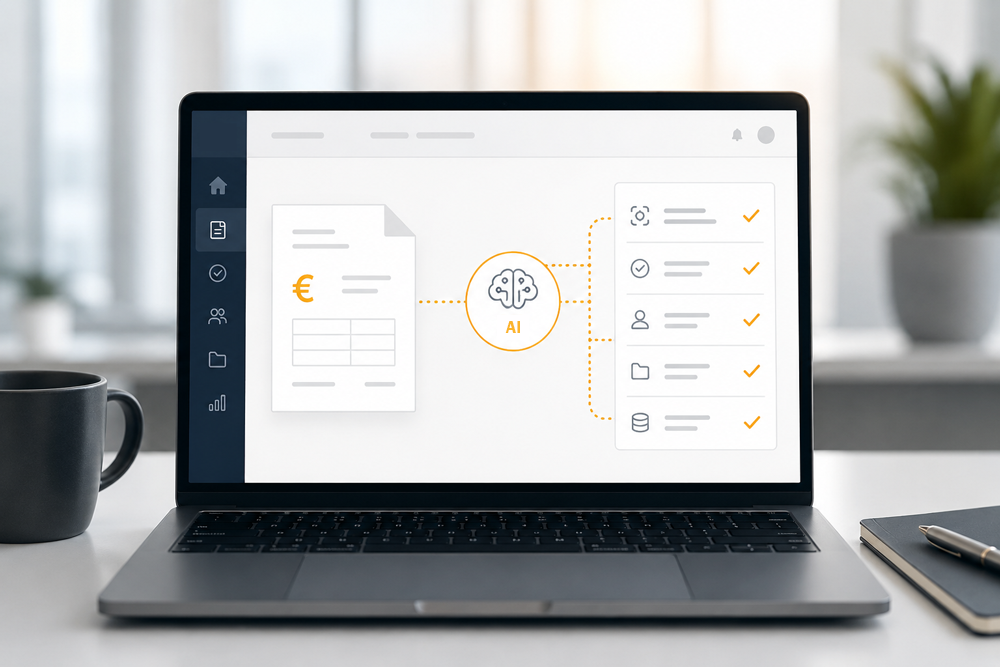
The answer lies in technology-agnostic, AI-powered processing systems. Modern digital invoice processing solutions from free-com are not dependent on a specific input format. Whether in XML, ZUGFeRD, XRechnung, PDF, or as a scanned paper document—incoming documents are automatically recognized, parsed, and processed in a structured format. OCR (Optical Character Recognition) technology and machine learning ensure that the system continuously improves and can process new formats without the need for time-consuming training.
A Summary of Electronic Invoice Formats
The landscape of e-invoice formats is complex, but not overwhelming. With XRechnung and ZUGFeRD, Germany has clear, well-documented standards for the B2B sector. In Austria, ebInterface dominates the B2G sector, while there is currently no requirement for B2B. But the course toward structured formats has long been set, at the latest by the EU ViDA Directive, which takes effect in 2030.
Companies that invest today in a flexible, AI-powered invoice processing solution are not only ensuring compliance for the coming years. They are also gaining a real economic advantage: shorter processing times, fewer errors, and greater transparency speak for themselves.
Do you have any questions for us?
We would be happy to advise you during a brief, no-obligation online consultation!
Frequently Asked Questions About E-Invoice Formats
Do You Have Any Questions For Us?
We will be happy to consult you during a short, non-binding online appointment!