AI in Invoice Processing: What Really Happens After an Invoice Is Received
Veröffentlicht am 16.06.2026
Lesedauer: 15 min
Contents
Inhalt
An invoice arrives. In many companies, this moment still does not trigger an automated process, but rather a mini-adventure: searching for the invoice, verifying the data, locating the purchase order, obtaining approval, determining the cost center, answering queries, posting the entry, and archiving the document. If, on top of that, someone is out sick, the invoice was sent to the wrong person, or the purchase order reference is missing, a simple document can quickly turn into chaos. In many companies, therefore, the process between “invoice received” and “invoice posted” costs more time, money, and stress than it should.
Often Underestimated: the Costs of Incoming Invoices
According to industry studies, manually processing a single incoming invoice costs between 12 and 30 euros, depending on company size, personnel costs, and process structure. Included in this are: labor time for data entry, effort for follow-up inquiries and corrections, and costs for physical forwarding and archiving.
For a medium-sized company with 500 incoming invoices per month, this quickly adds up to a significant expense. Added to this are the hidden costs: cash discounts that expire due to long processing times; reminders that arise because the status is unclear; or approvals that are left pending because the person responsible is on vacation.
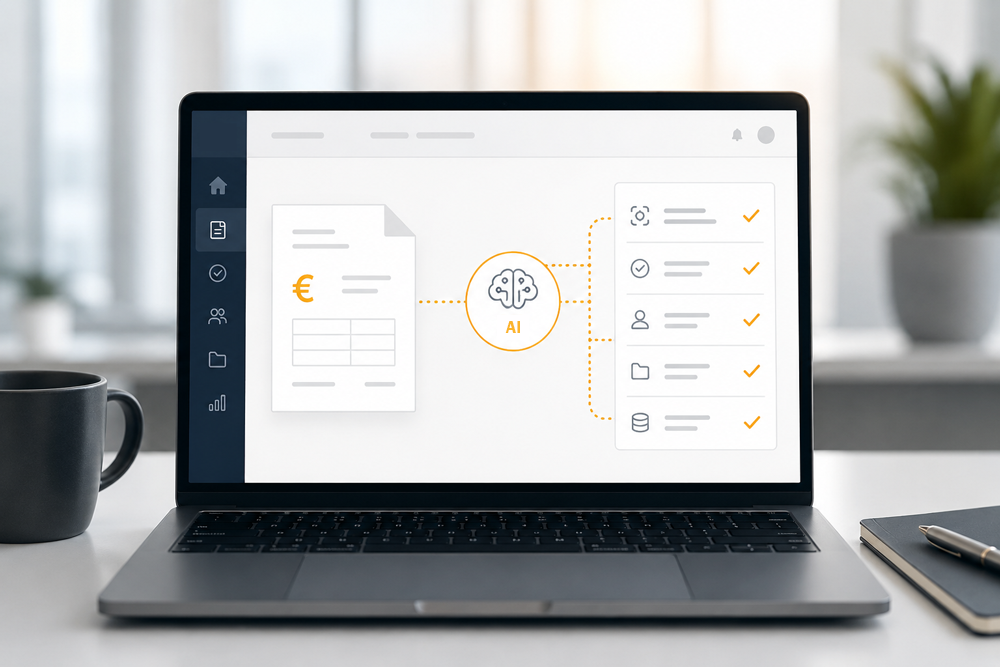
This is exactly where AI makes a difference in invoice processing. It can handle a number of specific tasks: extracting data, identifying discrepancies, suggesting account assignments, preparing audits, managing workflows, and displaying the processing status.
In the following chapters, we explain how AI, accounting, and automation (can) work together seamlessly.
The Journey of an Invoice Through Your Company
A professional digital solution for incoming invoice processing does not only consider individual functions. It maps the entire process.
The typical journey of an invoice looks like this:
Format Is Not Process: What E-Invoicing, XRechnung, and ZUGFeRD Do Not Solve
Since January 1, 2025, companies in Germany have been required to be able to receive e-invoices in the B2B sector. In Austria, the e-invoicing requirement currently applies only to federal authorities. A general B2B requirement is expected to take effect in 2030 under the EU’s VIDA Directive.
Structured formats such as XRechnung, ZUGFeRD, or ebInterface ensure that invoice data is available in a machine-readable format. This is a major improvement over PDF files or scanned paper documents. However, a structured format does not replace a process.
The Most Common Misconception About E-Invoicing
An XRechnung or ZUGFeRD file provides machine-readable data. But it does not answer the following questions: Does the invoice match the order? Who needs to approve it? Which account should it be posted to? Has it been submitted before? Is it archived in an audit-proof manner?
The structured format solves the data capture issue, but it does not solve the process.
If you receive an XRechnung but still manually assign it to an account, manually approve it, and manually archive it, then you have only postponed the media discontinuity.
AI in Invoice Processing: What It Actually Does
We explain the fundamental technology layers—from OCR to LLM to Agentic AI Accounting—in detail in our guide “The Evolution of AI in Intelligent Document Processing”.
What do these technologies mean specifically for accounting? What benefits does AI offer here?
AI Extracts Invoice Data
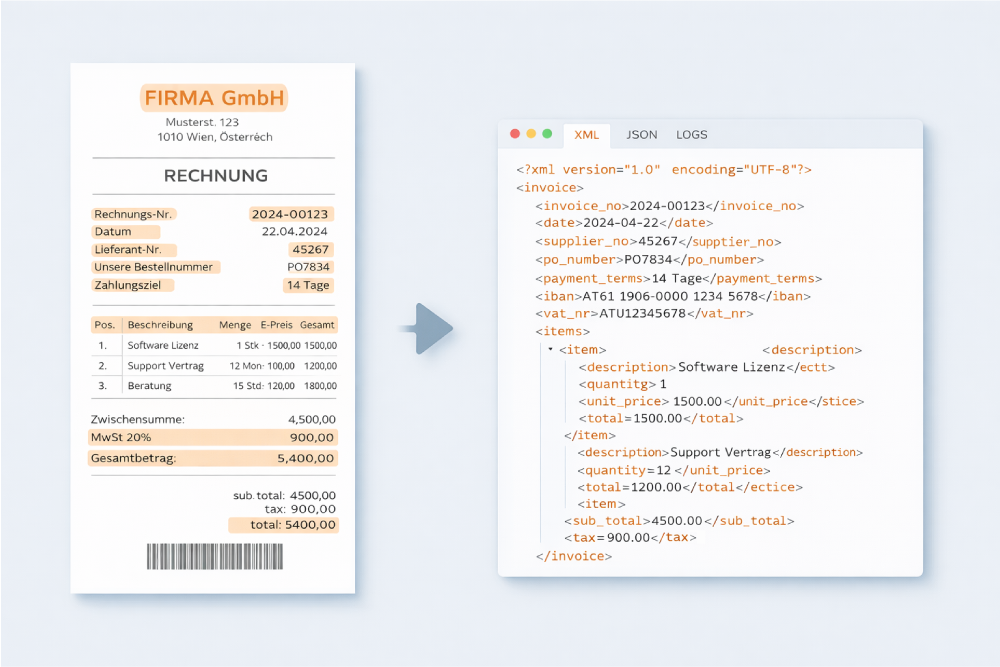
The most obvious application is automatic data extraction. This involves recognizing relevant information from PDF files, scans, paper documents, XML files, or hybrid formats and presenting it in a structured manner.
The difference from traditional OCR: Modern AI solutions not only recognize characters but also interpret relationships. For example, they understand which number is the invoice number, which line item corresponds to which amount, and which payment terms apply.
This is particularly important in cases of:
- varying invoice layouts
- international suppliers
- large volumes of line item data
- special invoices
- poorly structured PDFs
- combined documents
AI Detects Discrepancies
An invoice is not automatically correct just because it has been scanned correctly. AI can detect discrepancies and flag them for review.
For example:
- The total invoice amount does not match the line item totals
- The tax amount is suspicious
- The order number is missing
- The price differs from the order
- The delivery quantity does not match the delivery note
- The invoice could be a duplicate
- Payment terms differ from known supplier terms
This is where AI becomes particularly valuable: it helps the accounting department avoid having to review every invoice with the same level of scrutiny. Standard cases are processed faster. Suspicious cases, on the other hand, receive more attention.
AI Supports 2-Way and 3-Way Matching
In a 2-way match, the invoice is compared with the purchase order. In a 3-way match, the delivery note or goods receipt is also included. This is one of the biggest drivers of automation. Because if the invoice, purchase order, and delivery match perfectly, an invoice can be processed much faster. If not, the system must clearly indicate the discrepancy and forward it to the right person.
A good AI solution not only recognizes head data records but also works with line item data. This is where a particularly large number of the costly special cases are found.
AI Suggests Account Assignments
If a supplier regularly bills for similar services, if cost centers recur, or if certain posting combinations are historically plausible, AI can make suggestions.
For example:
- G/L account
- Cost center
- Project
- Cost object
- Tax code
- Posting text
This does not mean that AI makes decisions on its own. But it makes good suggestions and reduces routine work.
AI Manages Approvals More Intelligently
AI can help route invoices more effectively based on specific criteria:
- Supplier
- Amount
- Cost center
- Order reference
- Project
- Department
- Variance type
- Risk indicators
This reduces misassigned approvals and speeds up clarifications.
AI Makes Status Visible
One of the most important features is the transparency of an intelligent solution. It displays the processing status: received, reviewed, checked, pending approval, rejected, posted, archived. For CFOs and finance managers, questthis means clarity and control without having to ask questions.
The Three Levers with the Greatest Impact:
- AI extraction: Every hour an accountant does not spend typing data is an hour they can devote to analysis, clarification, and strategic tasks. With 500 invoices per month, that adds up to several full-time days.
- 2-Way/3-Way-Match:The automatic reconciliation of invoices, purchase orders, and goods receipts not only reduces manual work but also minimizes the risk of posting errors, duplicate payments, and unauthorized invoices.
- Account assignment suggestion with vendor-level learning:The system learns at the level of individual suppliers: Which cost center? Which account? For known suppliers, the AI makes suggestions with very high accuracy. The accountant reviews and confirms them instead of starting from scratch.
Straight Through Processing as an Objective and What It Requires
The goal of any AI-powered invoice processing system is to achieve the highest possible straight-through-processing rate. This refers to the percentage of invoices that are processed entirely automatically – without manual intervention – from receipt through to posting.
However, achieving a high straight-through-processing rate requires several prerequisites:
- Clean master data: If suppliers are duplicated or account data is missing, automatic reconciliation fails.
- Clearly defined process rules: AI needs clear rules: At what amount is manual approval required? Who is responsible for which cost center? Without rules, meaningful automation is not possible.
- Reliable ERP/Financial Accounting Integration: Straight-through-processing does not end with extraction. It is only complete when data arrives in the ERP system without any manual intermediate steps.
- Exception handling: Good automation recognizes what it cannot process with certainty. Clear escalation rules for special cases are not a weakness, but an important quality feature.
- Quality assurance: An AI consensus principle (multiple LLMs mutually validate each other) ensures that only verified results are automatically forwarded.
- Proper Archiving: Straight-through processing does not end with posting. Every automatically processed invoice must be archived in a structured, traceable, and audit-proof manner with a complete audit trail.
For more on straight-through processing and the AI consensus principle, see our glossary on intelligent document processing.
Testing Special Cases: How to Spot Good AI Solutions
Most solutions seem convincing when the invoice is straightforward: one supplier, one page, one line item, no discrepancies, and proper formatting. But that’s rarely the case in real life.
The quality of an AI solution becomes apparent when dealing with special cases. In practice, these often include:
- Credit invoices: Does the system recognize that this is not a standard invoice? Is the amount handled correctly? Is the workflow adjusted?
- Partial deliveries: Does the invoice match only part of the order? Are there multiple delivery notes? Was only part of the order delivered, but everything billed?
- Foreign currencies: Are the currency, exchange rate logic, and amounts correctly identified? Are net, tax, and gross amounts interpreted correctly?
- Non-standard layouts: Can the system handle new suppliers without having to manually train each layout? Does the system recognize new layouts if existing suppliers change them? Does this require manual retraining?
- Missing order reference: What happens if there is no order number on the invoice? Is the invoice automatically forwarded for clarification? Are there suggestions based on supplier, amount, or history?
- Large amounts of line item data: Are only header data recognized, or are line items also processed accurately? Especially in industry, retail, and manufacturing, this determines the actual benefit.
- Duplicate submissions: The same supplier sends an invoice twice. Does the system detect the duplicate, even if the date or format differs slightly?
- Reminders for invoices that have already been paid: Does the system recognize that this is not a new invoice? Is a possible link established to an outstanding invoice?
What Special Cases Reveal About a Solution
A good AI solution doesn’t promise 100% error-free processing. It promises that exceptions will be reliably detected, transparently escalated, and handled in a traceable manner. The ability to handle exceptions cleanly is the quality feature that is not shown in any demo, but makes all the difference in everyday use.
Agentic AI in Accounting: Why It Makes Sense
While traditional automation typically operates according to fixed rules, Agentic AI can prepare, review, and process tasks in a more targeted manner across multiple steps. It is important to note that it does not function as an uncontrolled autopilot, but rather as an assistance system with clear boundaries.
In invoice processing, for example, this can mean:
- Compiling invoice data from various sources
- Identifying missing information
- Prioritizing discrepancies
- Preparing verification steps
- Making suggestions for account assignment and workflow
- Structuring follow-up inquiries
- Triggering the next process steps
Governance is crucial. An Agentic AI solution in accounting must not make creative decisions. It must be transparent, controllable, and integrated into defined processes.
Agentic AI Accounting with Solutions from free-com
free-com views invoice processing not as a standalone function, but as a seamless end-to-end process. This means that receipt, data extraction, verification, approval, account assignment, posting, transfer to the ERP or financial accounting system, and archiving are all integral parts of a single, continuous workflow.
The following features make invoice processing a seamless AI-powered process:
- AI Consensus Principle: Multiple language models (LLMs) process each invoice independently of one another. Only when there is agreement (consensus) is the result marked as verified and automatically forwarded. In case of discrepancies: targeted escalation for manual review. This significantly increases the reliability of straight-through-processing.
- Vendor-Level Learning:The system learns at the level of individual vendors. The longer it runs, the more precise the account assignment suggestions and recognition rates become for known vendors.
- All Incoming Formats: Paper, PDF, scan, XML, XRechnung, ZUGFeRD, ebInterface: all common formats are processed in a seamless workflow.
- ERP/Financial Accounting Integration: Seamless integration with all common systems: SAP, Microsoft Dynamics 365, BMD, DATEV, and others. No duplicate data entry, no media discontinuity.
- GDPR and Data Sovereignty: All LLM instances are hosted exclusively in Europe. Customer data does not leave the European legal jurisdiction. No training with company data for public models.
- Flexible approval workflows: Approvals are controlled based on rules – depending on the amount, supplier, cost center, variance, or organizational unit. This reduces processing times and clarifies responsibilities.
- Account assignment suggestions: The system supports accounting with intelligent suggestions for G/L accounts, cost centers, projects, or other posting dimensions. Final control remains where it belongs: within the company.
- 2-Way / 3-Way-Match: Purchase orders, delivery notes, and invoices can be automatically matched, and discrepancies are highlighted.
- Audit-proof archiving: GoBD-compliant (Germany) and BAO-compliant (Austria). Every processing step is documented in a traceable manner.
- User guidance: Approvals, status queries, and follow-up requests are handled via a clear interface that can be used even by business departments without IT expertise.
Conclusion: AI in Accounting Pays Off
Invoice processing is one of the areas where AI automation has an immediate and measurable impact: less effort, fewer errors, shorter turnaround times, and more guaranteed discounts. However, the benefits only materialize when AI is part of a seamless end-to-end process: from invoice receipt through data extraction, verification, approval, account assignment, and ERP transfer to audit-proof archiving.
What distinguishes a good solution from a poor one is the ability to handle special cases cleanly, transparently escalate exceptions, integrate seamlessly into existing systems, and be GDPR-compliant.
Do You Have Any Questions For Us?
We will be happy to consult you during a short, non-binding online appointment!