Invoice Requirements in Austria: Mandatory Information, Exceptions, and Consequences
Veröffentlicht am 22.09.2026
Lesedauer: 7 min
Contents
- When Must an Invoice Be Issued?
- Mandatory Invoice Components in Austria
- Simplifications and Special Rules for Creating Invoices
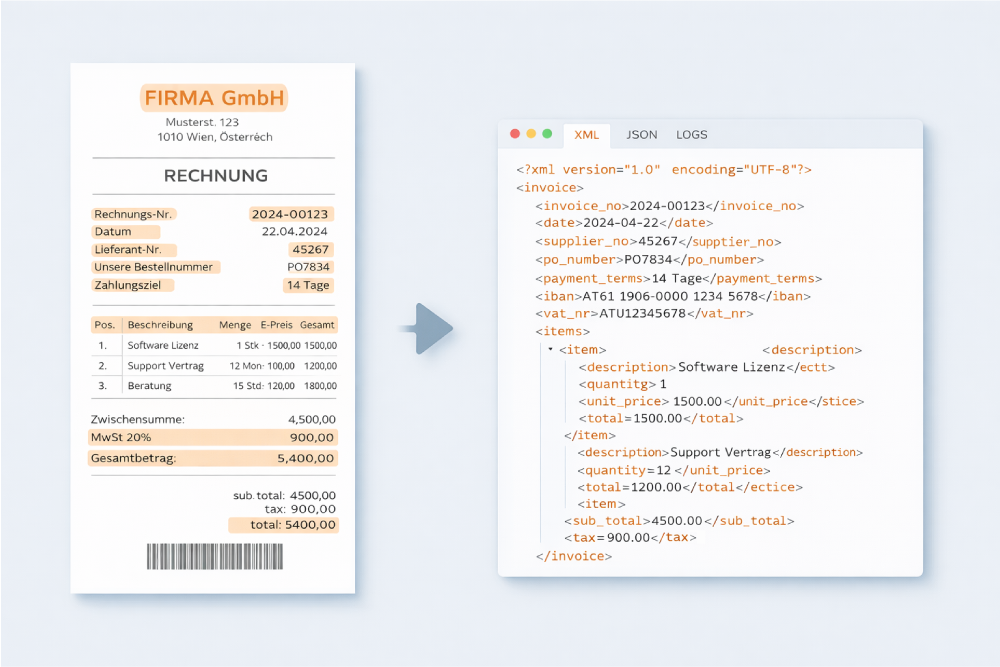
- Brief Digression: E-Invoices in Austria
- Consequences of Incorrect or Incomplete Invoices
- Issue Invoices Correctly Today, Be Well Prepared Tomorrow
- Frequently Asked Questions About Invoice Requirements in Austria
Inhalt
- When Must an Invoice Be Issued?
- Mandatory Invoice Components in Austria
- Simplifications and Special Rules for Creating Invoices
- Brief Digression: E-Invoices in Austria
- Consequences of Incorrect or Incomplete Invoices
- Issue Invoices Correctly Today, Be Well Prepared Tomorrow
- Frequently Asked Questions About Invoice Requirements in Austria
Anyone doing business as an entrepreneur in Austria cannot avoid issuing invoices correctly. If mandatory information is missing, the invoice recipient risks losing their input VAT deduction and the issuer may face problems during a tax audit. Creating a legally compliant invoice is not that difficult, provided you know what matters.
This article provides a compact overview of all statutory invoice requirements in Austria under § 11 of the Austrian VAT Act, explains special rules and shows what consequences incorrect invoices can have.
When Must an Invoice Be Issued?
Under § 11 para. 1 of the Austrian VAT Act, a proper invoice must contain certain information. But first, there is a more basic question: when does an invoice actually have to be issued?
As a general rule, companies that provide goods or services to other companies (B2B) are required under § 11 of the Austrian VAT Act to issue an invoice. The deadline is six months from the date the service or delivery was performed. In the B2C sector, meaning services provided to private individuals, this obligation only applies if the service is connected to real estate, for example construction work or repairs to a residential property.
Therefore, in Austria there is no general legal obligation to issue an invoice for, for example, cash sales to end consumers. In such cases, issuing a receipt, for example a cash register receipt, is sufficient. However, if the customer requests an invoice, it must be issued.
Mandatory Invoice Components in Austria
Invoice requirements are legally prescribed mandatory details that every invoice in Austria must contain. Specifically, § 11 of the Austrian VAT Act requires the following eleven details:

| # | Mandatory Information | Note |
|---|---|---|
| 1 | Name and Address of the Supplying Company | Full Company Name |
| 2 | Name and Address of the Recipient | Full Company Name or Name |
| 3 | UID Number of the Supplying Company | Where Available |
| 4 | Quantity and Customary Commercial Description of the Delivery or Type and Scope of the Service | Precise Description of the Service |
| 5 | Date of Delivery or Other Service | Service Date or Service Period |
| 6 | Consideration (Net Amount) | Broken Down by Tax Rates |
| 7 | Applicable Tax Rate | e.g. 20 %, 10 %, 13 % |
| 8 | Tax Amount Attributable to the Consideration | In Euros |
| 9 | Invoice Issue Date | – |
| 10 | Sequential Invoice Number | Assigned Uniquely and Systematically |
| 11 | UID Number of the Recipient | Mandatory for invoices over €10,000 gross if the recipient is an entrepreneur |
Common Practical Mistake: The service description is too vague, for example only “consulting” instead of “tax advisory services for the period January to March 2025”. The tax office expects a description that makes the service provided clearly identifiable.
Simplifications and Special Rules for Creating Invoices
Depending on the company situation or invoice amount, different requirements may apply in Austria that can make invoicing significantly easier.
Low-Value Invoices (Up to €400 Gross)
A low-value invoice is an invoice up to €400 gross under § 11 para. 6 of the Austrian VAT Act. Some mandatory details are not required in this case: the recipient’s name and address, their UID number and a separate tax statement are not necessary. The gross amount together with the applicable tax rate is sufficient.
However, the following details remain mandatory even for low-value invoices:
- Name and Address of the Supplying Company
- Quantity and Customary Commercial Description of the Delivery or Type and Scope of the Service
- Date of Delivery or Service
- Issue Date
- Gross Amount and Applicable Tax Rate
Typical use cases include cash register receipts, restaurant bills or small trade jobs.
Invoice Components for Small Businesses
Companies that fall under the small business exemption pursuant to § 6 para. 1 item 27 of the Austrian VAT Act are exempt from VAT and may not show VAT on their invoices. Instead, the following note is mandatory on the invoice: “VAT-exempt pursuant to § 6 para. 1 item 27 of the Austrian VAT Act”.
Since 2025, small businesses may issue all invoices according to the simplified rules for low-value invoices, regardless of the invoice amount. This significantly reduces the effort required to create invoices.
Important: The revenue threshold for the small business exemption is currently €55,000 net revenue per calendar year. If this threshold is exceeded, the exemption ceases to apply and all invoice requirements under § 11 of the Austrian VAT Act apply again in full.
The Standing Invoice
In Austria, a standing invoice is an invoice for recurring services that saves time and effort because it applies to the entire service period instead of requiring individual invoices. Typical use cases include rental agreements, maintenance contracts, subscriptions or ongoing service retainers.
A standing invoice must contain the same mandatory details as an individual invoice. It must also be labelled as such. In practice, the note “standing invoice within the meaning of § 14 of the Austrian VAT Act” has become established.
Standing invoices are only permissible as long as the amount, scope of services and VAT rate do not change. If even one of these components changes, a new invoice must be issued.
Brief Digression: E-Invoices in Austria
Unlike Germany, Austria has not yet introduced a general e-invoicing obligation between companies (B2B) in 2026. The obligation to issue an electronic invoice currently only applies to business transactions with the federal government (B2G).
At EU level, the ViDA directive will introduce an obligation for intra-Community B2B supplies from 1 July 2030. Companies that regularly operate across borders should therefore address this topic early. Important to know: a simple PDF invoice sent by email does not count as an e-invoice. It is not machine-readable and does not meet the legal definition.
You can read more about the technical requirements in our article: Electronic Invoice: Requirements and Prerequisites.
Consequences of Incorrect or Incomplete Invoices
Anyone who issues an invoice with missing mandatory information risks a lot:
Loss of Input VAT Deduction
If a business customer receives an invoice with missing mandatory information, they cannot deduct input VAT. This means that the invoice issuer’s mistake effectively costs the recipient up to 20 % of the invoice amount.
Problems During a Tax Audit
The tax office reviews invoices carefully. If details such as the sequential invoice number or UID number are missing, invoices may not be recognised.
Additional Tax Claims
In the case of repeatedly incorrect invoices, the tax office may issue additional tax claims. This can apply retrospectively for several years, provided the Retention Obligation (7 years) is still running.
A defective invoice can be corrected: either by issuing a corrected invoice with a reference to the original invoice number or by issuing a cancellation invoice and creating a new invoice.
Important: The correction must be sent to the recipient, otherwise the input VAT deduction cannot be claimed retroactively.
Issue Invoices Correctly Today, Be Well Prepared Tomorrow
The statutory invoice requirements in Austria are clearly regulated. They secure the input VAT deduction, help avoid additional tax claims and create trust in business transactions. Companies that have the mandatory information under § 11 of the Austrian VAT Act under control and correctly apply special rules such as standing invoices or the small business exemption are well positioned. And with a view to the upcoming e-invoicing obligation, it is worth optimising processes early.
As requirements continue to grow, structured invoice processing is becoming essential. free-com therefore recommends using digital invoice processing to ensure that incoming invoices are automatically checked for completeness, approved and archived in an audit-proof manner. This puts you in a strong position for the developments ahead.
Do You Have Any Questions For Us?
We will be happy to consult you during a short, non-binding online appointment!