AI in document management: use cases, benefits and real-world examples
Veröffentlicht am 03.11.2026
Lesedauer: 10 min

Contents
- What does AI in document management mean?
- For which document and file types is AI suitable?
- What are the benefits of AI in document management?
- How does AI support document management in practice?
- Practical example: an AI-managed supplier file
- What to consider when introducing AI in document management
- AI in document management with free-com
- Frequently asked questions about AI in document management
Inhalt
- What does AI in document management mean?
- For which document and file types is AI suitable?
- What are the benefits of AI in document management?
- How does AI support document management in practice?
- Practical example: an AI-managed supplier file
- What to consider when introducing AI in document management
- AI in document management with free-com
- Frequently asked questions about AI in document management
In many organisations, the volume of documents is growing faster than the capacity to manage it. Documents are filed but cannot be found. Versions overwrite one another. It is unclear who has access to which file. And when an audit comes round, there is no record of who viewed what and when.
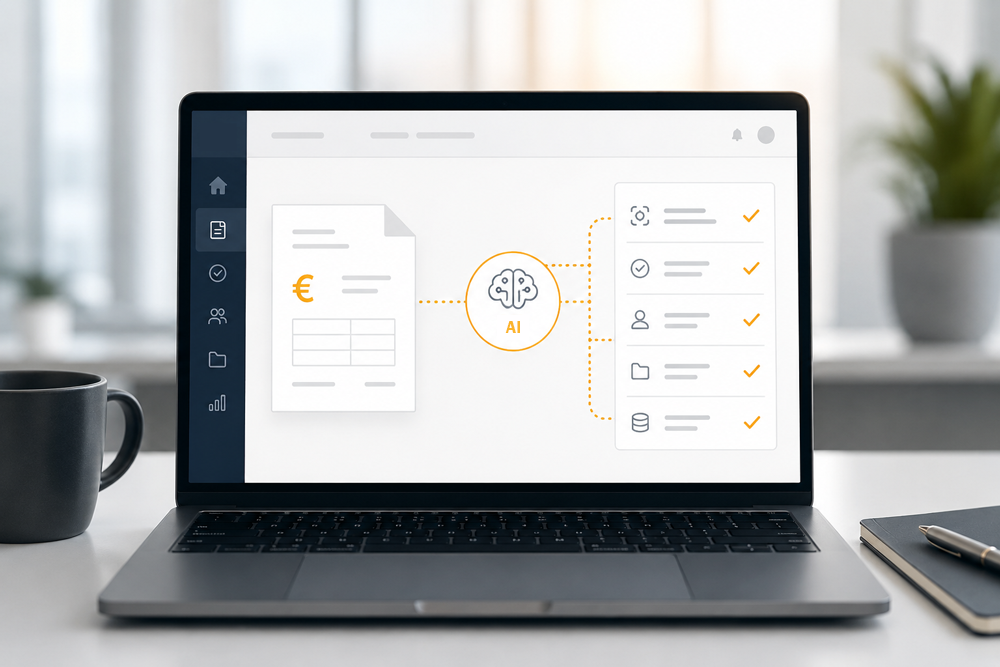
This is exactly where AI in document management comes in – not in the processing of individual business documents, but in the organisation, findability and governance of the entire document repository.
In this article, you will learn how AI is used in practice in document management: in automatic classification and filing, intelligent search and the management of digital files, as well as in permissions, versioning and archiving.
What does AI in document management mean?
A document management system (DMS) organises company documents centrally: it stores and structures them and makes them available to the right people at the right time. This includes contracts, personnel files, project documentation, correspondence and all other documents that are created or received within the organisation.
Without AI, a DMS is essentially a digital filing system. Documents have to be categorised, tagged and assigned manually. With AI, the system handles these tasks independently: it recognises the document type, assigns metadata automatically, allocates the document to the correct file and makes it findable through semantic search.
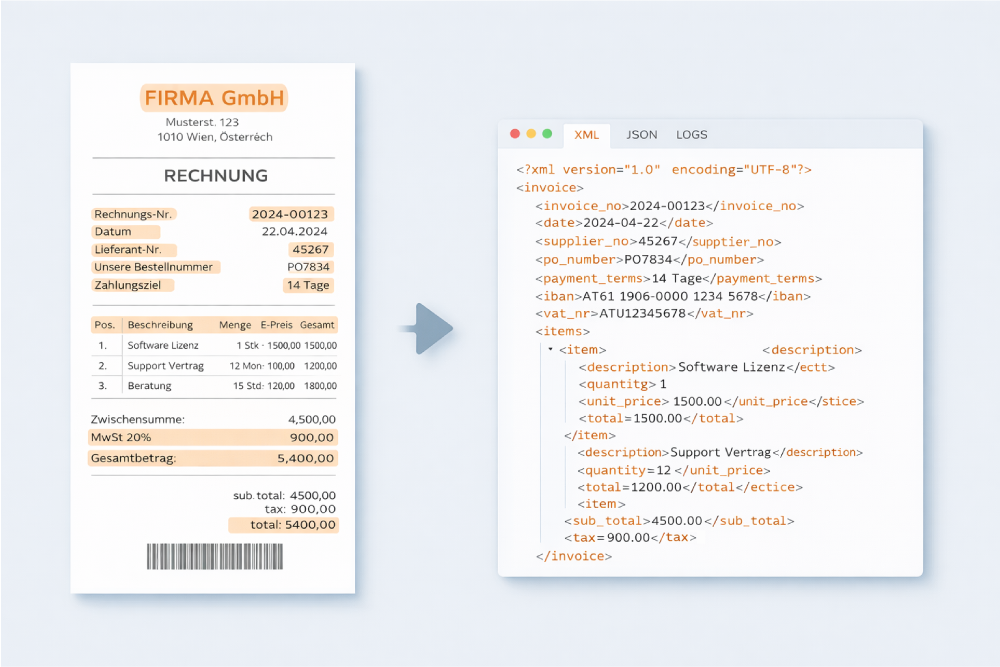
It is important to distinguish this from AI in document processing. Whereas document processing refers to the workflow for individual business documents – extraction, verification, approval and posting – document management is concerned with the long-term organisation, governance and findability of the entire document repository.
For which document and file types is AI suitable?
AI in a DMS is not limited to specific types of business document. It is particularly effective wherever large volumes of documents with a similar structure are generated, several people need access and governance requirements apply.
Contract management
Contracts typically go through several versions, are edited by different parties and have to be retained for years. AI classifies incoming contract documents, automatically recognises the contract number, term and contracting party and captures them as metadata, and allocates the document to the correct file. Expiry dates and notice periods can be stored as structured metadata and monitored automatically.
Personnel files and HR documents
In personnel administration, documents such as employment contracts, references, proof of qualifications and timesheets are generated on a regular basis. AI automatically allocates them to the correct personnel file and keeps the file complete, without any need for manual data entry.
Customer and supplier files
Customer and supplier files contain contracts, correspondence, certificates, agreed terms and other documents that build up over many years. AI ensures that newly received documents are automatically allocated to the correct file – based on their content and context, rather than solely on manually entered reference numbers.
Project files
Project files bring together quotations, purchase orders, delivery documents, meeting minutes and billing documents. AI identifies which project a document belongs to and allocates it automatically, even when different departments use different names for the same project.
What are the benefits of AI in document management?
Extending a DMS with AI delivers benefits that go beyond simple time savings. The real added value lies in consistency: metadata is always assigned according to the same rules, documents always end up in the right place and access rights are applied reliably. This cannot be guaranteed with purely manual processes.
Consistent filing that doesn’t depend on individuals
Manual filing depends on the diligence of each individual employee. AI standardises classification and the assignment of metadata, regardless of who files a document or how it was named.
Automated governance and compliance
Retention periods, access rights and versioning rules can be configured in the system and enforced automatically. The AI carries out compliance checks and ensures that both statutory and internal requirements are met.
Faster, more accurate search
AI enables context-based search queries and delivers more accurate results than a simple keyword search. Even when the search terms do not appear verbatim in a document, the system finds relevant results based on content and context.
Complete digital files
Newly received documents are automatically allocated to the correct customer, supplier or project file. Files remain complete – not because someone remembers to update them, but because the system ensures it.
Scalable without additional effort
Even as the volume of documents grows, the manual workload does not increase with it. AI handles large numbers of documents with consistent quality.
How does AI support document management in practice?
AI comes into play at several stages of the document lifecycle: from automatic recognition and filing on receipt, through the assignment of metadata, to semantic search, access control and audit-proof archiving. Below is an overview of the individual components.
Automatic classification and filing
When a document is received, AI analyses its content, structure and context and classifies it automatically. Is it a contract, a piece of correspondence, a certificate or a set of minutes? Which customer, supplier or project does it belong to?
Based on this analysis, the document is automatically filed in the correct location within the DMS. Modern AI document management solutions do not require any prior training on specific layouts or senders to do this. Classification is based on the actual content of the document.
Metadata, tags and document types
For documents to remain findable and manageable in a DMS, they need structured metadata: document type, date, associated customer, supplier or project, status and retention period. Data such as names, amounts, products and delivery dates can be extracted automatically and stored as metadata. This simplifies organisation and makes documents reliably findable, even without manual tagging.
Tags are assigned based on content rather than on fixed rules that fail when faced with unfamiliar formats. This keeps metadata quality consistent, even as the document repository grows.
Intelligent and semantic search
Conventional DMS search relies on file names or exact keywords. If you do not know what a document was called, you often will not find it.
AI-powered document analysis enables semantic search: the system understands the meaning of a search query and returns relevant results, even when the search terms do not appear verbatim in the document. A search for ‘supply contract metal parts 2023’ will also find documents that were filed internally as ‘framework agreement steel components’. This is particularly valuable for large document repositories or those that have grown organically over time.
Permissions, versioning and governance
A DMS is only useful if there are clear rules on who is allowed to view, edit and approve which documents. Based on document type, content and association, AI can suggest suitable access roles. A contract with a customer automatically receives the permission structure that has been defined for customer documents.
When it comes to versioning, AI recognises when a newly received document replaces an earlier version and links the two together. This keeps the document history complete, even when documents are revised externally and resubmitted.
Retention and audit-proof archiving
Company documents are subject to statutory retention requirements, which vary by document type and country. Based on the identified document type, AI can automatically assign and monitor retention periods. When a retention period expires, the system flags it and either initiates the deletion process or submits it for manual approval.
Traceability is equally important. Who accessed a document, and when? Who changed it? Which version was shared? An AI-powered DMS logs these actions automatically and makes them instantly available during tax audits.
Practical example: an AI-managed supplier file
A concrete example shows how AI works in document management in practice. A medium-sized company works with several suppliers. For each supplier, there is a file in the DMS that is meant to contain framework agreements, quality certificates, correspondence and pricing agreements.
Without AI, incoming documents are reviewed, allocated and filed manually. Certificates expire without anyone noticing. Contracts exist in different versions on different drives. When preparing for a supplier audit, it can take hours to compile all the relevant documents.
With AI, incoming documents are automatically allocated to the correct supplier and document category. Certificate expiry dates are captured as metadata and monitored, and the system sends an alert in good time before a certificate expires. Versioning rules ensure that the current version of a contract is always clearly marked as such. For a supplier audit, all documents are complete and can be found in seconds.
What to consider when introducing AI in document management
Before deciding on a solution, it is worth looking at the basic requirements for a DMS. When introducing AI in document management, the following points also need to be considered:
AI in document management with free-com
Microsoft SharePoint is already in use in many companies as a platform for filing and collaboration. With the right add-on, SharePoint can be expanded into a fully fledged AI-powered DMS, including automatic classification, metadata assignment, semantic search, a file structure and audit-proof archiving.
free-com helps companies set up and extend SharePoint as a central platform for AI-powered document management. The advantage over introducing a separate system is that companies build on infrastructure that is already in place and familiar to their employees. This reduces the implementation effort and makes adoption easier.
In addition to SharePoint and Microsoft 365, free-com also supports SAP environments. Documents can be managed directly within the SAP system, including AI-supported filing and digital archiving within the familiar working environment.
Would you like to find out how much time your company could save with AI-supported processes? Book a free, no-obligation consultation with us.
Do You Have Any Questions For Us?
We will be happy to consult you during a short, non-binding online appointment!