Retention Periods for Delivery Notes: Rules in Austria and Germany
Veröffentlicht am 20.10.2026
Lesedauer: 8 min

Contents
- What Is a Delivery Note and Why Is It Important?
- Which Delivery Notes Are Subject to a Retention Obligation?
- Retention Periods for Delivery Notes in Austria
- Retention Periods for Delivery Notes in Germany
- How Must Delivery Notes Be Retained?
- Digital Archiving of Delivery Notes with free-com
- Consequences of Failing to Comply with Retention Obligations
- Checklist: How to Archive Delivery Notes Correctly
- Know Retention Periods for Delivery Notes and Avoid Risks
- Frequently Asked Questions About Retention Obligations for Delivery Notes
Inhalt
- What Is a Delivery Note and Why Is It Important?
- Which Delivery Notes Are Subject to a Retention Obligation?
- Retention Periods for Delivery Notes in Austria
- Retention Periods for Delivery Notes in Germany
- How Must Delivery Notes Be Retained?
- Digital Archiving of Delivery Notes with free-com
- Consequences of Failing to Comply with Retention Obligations
- Checklist: How to Archive Delivery Notes Correctly
- Know Retention Periods for Delivery Notes and Avoid Risks
- Frequently Asked Questions About Retention Obligations for Delivery Notes
Delivery notes are part of everyday business. But how long do they actually have to be retained? And does this apply to every delivery note? The answer depends on the function a delivery note fulfils in each specific case.
This article gives you a compact overview of the retention periods for delivery notes in Austria and Germany and explains when a legal retention obligation applies and how archiving should be implemented correctly.
What Is a Delivery Note and Why Is It Important?
A delivery note is an accompanying document that travels with a goods delivery and documents its contents. It typically includes details about the sender and recipient, the delivered goods (type, quantity, item number), the delivery date and a reference to the related purchase order or order number.
There is no general legal obligation to issue a delivery note. In practice, however, it is indispensable for several reasons:
- As proof of goods handover, it documents what was delivered and when, and protects both parties in the event of complaints, quantity disputes or warranty cases.
- As an accounting basis, it serves as proof of goods receipt for companies preparing balance sheets.
- During tax audits, the tax authority may request delivery notes as proof that services or deliveries were actually provided.
Companies that systematically archive delivery notes are therefore not only better positioned for compliance, but also protect themselves in the event of disputes or audits.
Which Delivery Notes Are Subject to a Retention Obligation?
Not every delivery note is automatically subject to a retention obligation. What matters is the function it fulfils in the respective business transaction:
Retention Periods for Delivery Notes in Austria
In Austria, the retention period for delivery notes is 7 years in most cases, regardless of whether the document is an accounting voucher, a business letter or a delivery note that also serves as an invoice. The legal basis is provided by the Austrian Federal Fiscal Code (BAO) and the Austrian Commercial Code (UGB).
An important exception applies to delivery notes related to real estate, for example in connection with construction projects or property. In these cases, the retention period is extended to 22 years.
| Function of the Delivery Note | Retention Period |
|---|---|
| Accounting Voucher (Companies preparing Balance Sheets) | 7 Years |
| Business Letter / Accompanying Document | 7 Years |
| Delivery Note = Invoice | 7 Years |
| Income-Expenditure Accounting (After Receipt of the Invoice) | No obligation |
| Real Estate Relevance | 22 Years |
When Does the Period Start?
The retention period starts on January 1 of the calendar year following the business transaction. A delivery note from March 2025 must therefore be retained at least until December 31, 2032.
Retention Periods for Delivery Notes in Germany
In Germany, the retention period depends on the function the delivery note fulfils. In principle, there are two relevant periods: 6 years for delivery notes that qualify as business or commercial letters, and 8 years for accounting-relevant documents. The 8-year period has applied since January 1, 2025. The legal basis can be found in the German Commercial Code (HGB) and the German Fiscal Code (AO).
| Function of the Delivery Note | Retention Period |
|---|---|
| Accounting Voucher (Companies preparing Balance Sheets) | 8 Years (since 2025) |
| Commercial Letter / Business Letter | 6 Years |
| Delivery Note = Invoice | 8 Years |
| Not relevant for Accounting | No statutory obligation |
When Does the Period Start?
The retention period begins at the end of the calendar year in which the delivery note was created. A delivery note from August 2025 must therefore be retained until December 31, 2033.
How Must Delivery Notes Be Retained?
The legal requirements apply equally to paper and digital documents. The following basic requirements must be met:
Completeness
All delivery notes subject to retention obligations must be archived without gaps. Missing documents may be considered a deficiency during a tax audit.
Accessibility
During a tax audit, the documents must be made available to the tax authority within a reasonable period of time. A well-organised filing system is therefore mandatory.
Legibility
The documents must remain legible for the entire retention period. Fading thermal paper receipts are a common problem in practice. Early scanning is therefore recommended.
Immutability
Digital retention is permitted, provided that the documents remain complete, unalterable, legible and available at all times throughout the entire retention period. An audit-proof system must be used (not a simple USB stick copy).
Digital Archiving of Delivery Notes with free-com
Managing paper delivery notes manually takes time, is prone to errors and uses up physical storage space. Documents relevant for tax purposes and all documents relating to business management must be archived. This explicitly includes delivery notes, accounting vouchers, incoming and outgoing invoices, contracts and business letters.
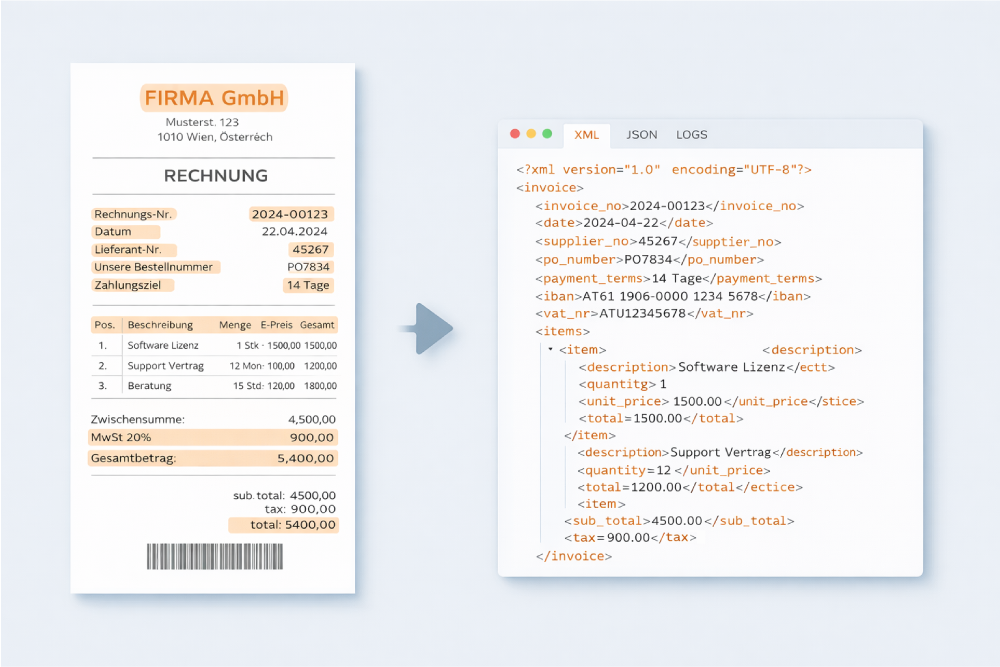
This is exactly where the free-com solution comes in: with automatic document recognition, delivery notes are read automatically, matched with order data and corrected or approved in just a few clicks. Both header data and line item data are captured and checked for correctness. This includes: date, purchase order number, supplier, order items as well as item quantities and item numbers.
At the end of the process, delivery notes are archived digitally in an audit-proof way: complete, structured and accessible at any time. This not only saves space and time, but also helps ensure compliance with statutory retention obligations. You can find out more in our article Digital Archiving: Everything You Need to Know.
Consequences of Failing to Comply with Retention Obligations
Companies that do not retain delivery notes, or do not retain them for long enough, risk concrete tax and legal disadvantages:
- Tax authority estimation powers: If documents subject to retention obligations are not retained, the tax authority may be entitled to estimate tax bases under § 184 BAO. The tax authority may then estimate revenues and profits independently, which is usually to the company’s disadvantage.
- Loss of input tax deduction: If documents that serve as the basis for input tax deduction are missing, the deduction may be denied.
- Problems with complaints: Without a delivery note, it is often no longer possible to prove in a dispute what was delivered, when and in what quantity. This significantly weakens your position towards suppliers or customers.
- More difficult tax audit: Missing documents lead to more intensive audits and may delay the completion of an audit.
Checklist: How to Archive Delivery Notes Correctly
With this checklist, you can keep an eye on the retention period for delivery notes and be well prepared for tax audits.
As staffing resources become increasingly scarce, free-com’s automatic document recognition can help. A manual checklist is no longer necessary.
Know Retention Periods for Delivery Notes and Avoid Risks
The retention obligation for delivery notes may sound complex, but it follows a clear logic: companies preparing balance sheets usually retain delivery notes for 7 years in Austria and 8 years in Germany. The decisive factor is always the function of the document: accounting voucher, business letter or purely accompanying document. In practice, digital archiving is the significantly more efficient solution. It saves space, makes documents easier to find and ensures audit-proof retention.
Do You Have Any Questions For Us?
Whether delivery receipts, order confirmations, incoming invoices, expense reports or other types of documents – our intelligent solution automatically reads all company documents and enables a transparent, location-independent approval process.
We would be happy to advise you in a short, non-binding online appointment!